Hopefully Good Friday

Hopefully Good Friday
Jude Madubuike | 3 April 2026

Hopefully Good Friday — that is how I find myself greeting this day. Not with easy cheerfulness, but with a determined, eyes-open hope. The kind of hope that looks at the cross, looks at the news, looks at the world, and still dares to believe that Love has the final word.

The story of Jesus is a story of sacrifice and grace. He came not as a conqueror but as a servant, and in giving His life, He offered humanity something no weapon has ever been able to provide: redemption, dignity, and the possibility of peace. The dove hovers over His whole story, from the waters of baptism to the glory of resurrection. Love came down. Love gave everything. He calls us to live by the Golden Rule: do unto others as you would have them do unto you.

We are living through a remarkable convergence of sacred seasons. Ramadan, Jewish celebrations, the Persian festival of Nowruz, light overcoming darkness, and here across Christendom, the final steps of Lent toward the cross and beyond it, toward the empty tomb. Across faiths, across cultures, across borders, humanity is turning its face toward hope and light.

But that hope was pierced on Palm Sunday, the day we remember Christ’s entry into Jerusalem and the beginning of His journey through Holy Week toward the cross. At least 27 people were killed in an attack on a mostly Christian community in Plateau State, Nigeria. Families gathered in prayer met by gunfire instead. We cannot sing resurrection songs while ignoring crucifixions still happening in our time.

Why would any human being decide to take the life of another, provoked or not? This should never become the norm.

This is also why; the question of nuclear weapons cannot be separated from our faith. There are approximately 12,500 nuclear warheads in the world today, enough to end the world that God so loved, many times over. And yet imagine what we could build instead with that same ingenuity and resource. Better lives. Healthier communities. A future worth inheriting.

Easter matters so deeply because Jesus’ resurrection is not simply doctrine. It is God’s most deliberate act. The disarming grace of God, refusing to let death have the final word, lifting our hearts toward a better world, a better humanity, a better earth. That grace moves through people. It moved through a stable in Bethlehem. It moved through a garden tomb. It can move through you.

So I speak directly to faith leaders: imams, rabbis, priests, pastors, elders, and all who carry a lamp in their communities. This is your moment. Be light bearers. Look your congregations in the eye and say: we were not made for this. We were made for life, for love, for one another.

Jesus rose. And His rising is an invitation to lift our eyes, lift our hearts, and lead the way toward a world worthy of the love that came down for it.

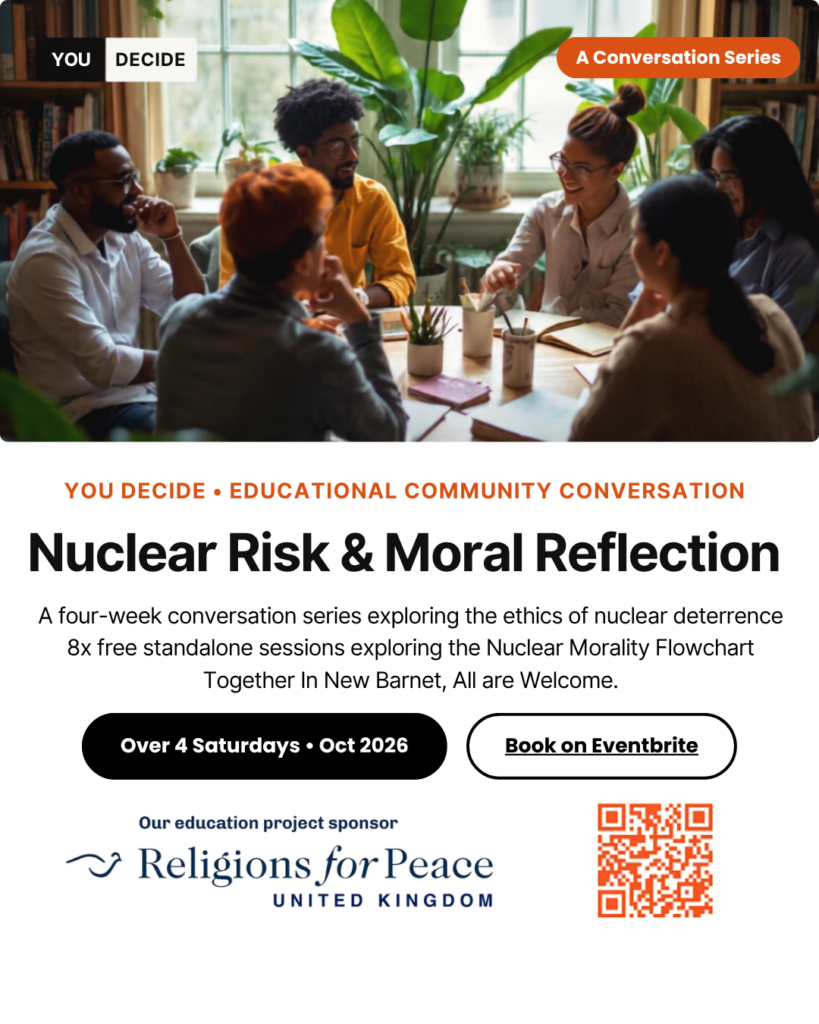
You shall not kill. Ever? That question is the beginning of a conversation this world urgently needs. I invite you to decide.

To explore the Nuclear Morality Flowchart and work through these questions for yourself, visit: nuclearmorality.com

I RAN Because IS REAL


I RAN Because IS REAL
Jude Madubuike | 23 March 2026

A word play. A warning. A moral question we can no longer avoid.

Read it again. Slowly.

I RAN.
Someone fleeing. Someone who had a choice or did not. Someone who grabbed a bag, called a relative in another country, checked the price of a flight before the airport closed. For them, “I ran” was not a phrase. It was a lifeline.

IS REAL.
A question folded inside a statement. Is this real? Can what we are watching really be happening, in 2026, in a world that signed treaties and told itself it had learned something from the last time?

Strip the spaces away and you have two nations — Iran and Israel — whose conflict has now spread across at least a dozen countries, disrupted the Strait of Hormuz, the world’s most critical oil artery, and killed more than 2,300 people across the region.

But the word play is saying something deeper than geography.

“I RAN” is the story of everyone who could leave. The ones with foreign passports, savings, relatives in cities untouched by sirens. Running was a choice they were lucky enough to have.

“IS REAL” is the question being lived by everyone left behind. The ones for whom running was never an option. And the ones on both sides of this conflict who are now sheltering, grieving, or simply trying to make it through the night.

Between those two words sits a gap. A moral gap that no government is asking us to examine.

You Decide thinks it is time we did.

What Is Happening and Who It Is Happening To
On 28 February 2026, the United States and Israel launched coordinated strikes on Iran. It became a regional war.

In Iran, at least 1,444 people have been killed, including at least 204 children. Air defences were activated over Tehran as the country tried to celebrate Nowruz, the Persian New Year. Over 200 cities have been hit. Among the targets struck: oil depots, schools, hospitals and residential areas. Iran’s Health Minister warned that acid rain from burning refineries would cause lasting environmental damage. On the morning of 28 February, the Shajareh Tayyebeh girls’ school in Minab was just starting the typical school day. Before noon, the classrooms were gone. A missile strike reportedly killed large numbers of schoolchildren and teachers.

In Israel, Iranian missiles struck the area around Dimona, home to Israel’s main nuclear research facility, wounding at least 180 people. Netanyahu called it “a very difficult evening.” A direct missile strike also hit a shelter inside a synagogue in Beit Shemesh, 18 miles from Jerusalem, killing nine civilians including children. Sirens did not sound in time to give residents the 90 seconds they needed to reach safety.

In Lebanon, at least 1,001 people have been killed since Israel renewed widespread attacks, including 118 children. Schools in Beirut are now being used as emergency shelters.

Across the Gulf, 13 US soldiers have been confirmed killed. In Bahrain, an Asian shipyard worker was killed when debris from an intercepted missile fell onto the vessel he was maintaining. A 29-year-old woman was killed and eight people injured when a residential building in Manama was struck. In Dubai, parents sheltered their children in underground car parks, telling them the explosions were Ramadan fireworks. A Filipino caregiver named Mary Anne de Vera was killed while assisting her elderly ward during a strike. In the Strait of Hormuz, Filipino seafarer George Miranda is missing and presumed dead after his tugboat was attacked during a rescue mission.

These are not statistics from a simulation. These are people. People who had names, routines, families waiting for them. People who had no vote in any of the decisions that brought this war to their door.

Conflict may be declared by states. It is always experienced by people.

The Question Nobody in Power Is Asking
The stated justification for striking Iran was its nuclear programme. Iran must not be allowed to develop nuclear weapons.

Now hold that sentence next to this fact.

Iranian missiles struck communities around Dimona, home to Israel’s nuclear research centre. Air defence systems failed to intercept them. Israel’s nuclear arsenal has never been officially acknowledged. It has also never been put to a vote. It exists without public moral consent.

The same object. The same destructive potential. Two entirely different moral verdicts, decided not by principle but by power.

If nuclear weapons are morally unacceptable, they must be unacceptable for everyone.
If they are justifiable, that justification cannot be selectively applied.

Neither answer is comfortable. Both demand a response.

And here is what makes it harder still. Diplomatic negotiations had been underway in February 2026. Progress had been made. Iran was engaging seriously with proposals that could have provided verifiable guarantees. The bombs fell anyway.

Diplomacy was not allowed to fail. It was not given the chance.

The Man in Tehran and the Children in Beit Shemesh
There is a man in Tehran. He is 25. He keeps his front door unlocked at night so he can sprint to his building’s underground car park the moment he hears an explosion. His relatives take only short trips outside, staying close to home, because buildings nearby have already been hit.

There is a shelter inside a synagogue in Beit Shemesh, Israel. It was built to protect people. On 1st March 2026, a direct missile strike hit it. Nine civilians were killed, including children. The sirens did not sound in time to give them the 90 seconds they needed.

The man in Tehran keeps his door unlocked so he can run.

The children in Beit Shemesh did not get to.

Both situations are true simultaneously.

Both are human.

The logic that put them in danger is the same logic.

And that logic has a name: Nuclear Deterrence.

This Is Where You Come In
At You Decide, our core conviction is this:

Nuclear deterrence is not only a matter of national policy. It is a personal moral decision.

That is not a slogan. It is a claim with consequences for the people sheltering in car parks in Tehran, the families in Beit Shemesh who did not reach their shelter in time, and the workers in Bahrain and the Gulf who had no connection to this conflict at all.

If you accept nuclear weapons for your defence, then morally you hold them in your own hands.

Not governments. Not generals. You.

The Nuclear Morality Flowchart was built for moments exactly like this one. It does not tell you what to think. It asks you to decide. It walks you, step by step, through the questions this conflict has forced into plain sight:

? Does nuclear deterrence prevent war, or only delay catastrophe while increasing risk?
? Can weapons that cannot distinguish a shelter from a school ever be morally justified?
? What responsibility do we carry for decisions made in our name?

You do not need to be a policymaker to engage with these questions. You need only ten minutes and the willingness to think honestly. The flowchart has been completed by Members of Parliament and by people who had never considered any of this before. Both found it changed how they saw things.

It is available in English, Chinese, Dutch, German and Farsi. Farsi is the language of Iran, spoken by the people living through this right now, in car parks and rubble and grief. That is not incidental. It is the whole point.


There Is a Way Through
Peace is not naive. It is harder than war, and it requires more of us.

Diplomatic negotiations had been producing real progress before the bombs fell. Iran was engaging seriously with proposals that could have provided verifiable guarantees on its nuclear programme. That process was ended, not exhausted.

The lesson is not that diplomacy failed. The lesson is that diplomacy requires people who insist on it loudly enough that governments cannot quietly set it aside. It requires citizens who understand what is being decided in their name, and who refuse to leave those decisions solely to those who have already made up their minds.

That is what You Decide exists to create. Not a movement of experts. A movement of people who have thought about this honestly, decided where they stand, and are willing to say so.

I RAN. IS REAL. You Decide.
“I RAN” and “IS REAL” are not just two nations at war.

They are the gap between those who can leave and those who cannot. Between those who decide and those who bear the consequences. Between the man keeping his door unlocked in Tehran and the children who did not reach the shelter in Beit Shemesh. Between a world that treats deterrence as policy and a world beginning to understand it as a moral emergency.

That gap will not close by itself.

It closes when you decide it must.

Complete the Nuclear Morality Flowchart at nuclearmorality.com

It takes ten minutes. It might change how you see everything.

Because nuclear deterrence is not just policy. It is a personal moral decision. You decide.

By Jude Madubuike
You Decide Director and Projects Leader
nuclearmorality.com | info@youdecide.org.uk

Sources and References
1. Al Jazeera Live Tracker, US-Israel attacks on Iran: Death toll and injuries, updated 23 March 2026. aljazeera.com
2. Al Jazeera, Iran says 1,255 people killed in US-Israeli attacks, mostly civilians, 9 March 2026. aljazeera.com
3. Al Jazeera, Iran strikes towns near Israel’s key nuclear site, at least 180 wounded, 21 March 2026. aljazeera.com
4. Al Jazeera, Did Israel miscalculate Iranian military capabilities?, 22 March 2026. aljazeera.com
5. Al Jazeera, Iran war: What is happening on day eight of US-Israel attacks?, 7 March 2026. aljazeera.com
6. Al Jazeera, Map shows how 22 days of attacks have evolved, 16 March 2026. aljazeera.com
7. ACLED, Middle East Special Issue: March 2026. acleddata.com
8. Rappler, Casualty Tracker: US-Israel war on Iran, updated 20 March 2026. rappler.com
9. nuclearmorality.com

Nuclear Deterrence: A Personal Moral Decision

You Decide Community Interest Company was founded in response to a profound moral question of our time.

Today, nuclear weapons remain central to global security strategies, yet the ethical implications of these weapons are rarely discussed outside strategic policy circles. The Nuclear Morality Flowchart was developed to change that by encouraging individuals and communities to reflect on the moral consequences of nuclear deterrence.

Our core conviction is simple: nuclear deterrence is not only a matter of national policy -it is a personal moral decision.

Recent events make this reflection increasingly urgent. Military tensions involving the United States, Israel and Iran have been framed partly as efforts to prevent Iran from developing nuclear weapons. Yet the situation raises an uncomfortable question: why are nuclear weapons unacceptable for some states, yet considered acceptable for others who already possess them?

At the same time, the war between Russia and Ukraine and renewed nuclear coordination among European powers such as France and Germany discussing new deterrence frameworks and nuclear coordination efforts, highlighting how the logic of deterrence continues to expand rather than diminish.

These developments raise fundamental ethical questions. Can nuclear weapons ever be justified under principles of just war when their effects would devastate civilian populations? Does nuclear deterrence truly prevent conflict, or does it simply postpone catastrophe while increasing the risks of escalation?

The Nuclear Morality Flowchart invites individuals to examine these questions through multiple perspectives, including moral responsibility, self-defence, international stability and the risks of escalation.

Rather than promoting ideology or political campaigns, the initiative seeks to create space for thoughtful reflection and dialogue as we are Called to be Peacemakers. Through education, workshops and community engagement, You Decide encourages people to confront the ethical dimensions of nuclear policy.

In a world where nuclear weapons continue to shape international politics, the responsibility to reflect on their consequences does not rest solely with governments.

It rests with all of us. Because ultimately, nuclear deterrence is not just policy.

It is a personal moral decision. You decide.

Jude Madubuike
Director and Project Leader
You Decide Community Interest Company
jude@youdecide.org.uk

Hope

In providing a reflection for the Anglican Pacifist Fellowship (APF) January prayer meeting, Martin was asked to introduce the You Decide project and the TPNW anniversary, as signs of hope.
Reflection on Hope – for APF Prayers 22/1/26
How can we stay hopeful when it seems like the world is on fire? Well, here are two hopeful signs, of progress on nuclear disarmament:

One is what I have called the Nuclear Morality Flowchart project (now called “You Decide”), and the other is the TPNW (the Treaty on Prohibition of Nuclear Weapons).
Some of you will be very familiar with both of these, but I’ll briefly explain each one and identify the signs of hope.
The Flowchart is basically a tool: it enables people to examine the ethics of nuclear deterrence. If you think it is totally unacceptable for us to be engineering the means to destroy millions of innocent lives for the purpose of our “defence”, then you might be thinking that we don’t need such a tool. But you will also know that here in the UK for example, there is a mindset , centred in Government, but widespread everywhere, inherited from 20th Century history, that says that nuclear deterrence is effective and acceptable.
It is a complex question, and people are misled by simple answers. The flowchart presents all the relevant questions, assembled in a logical network, which anyone can answer for themselves. They may then find themselves facing their own moral inconsistencies. Most people don’t really want to do this. One person told me he would not be tricked into answering my questions! But it can be a powerful tool to help us all be more rational and then more effective in bringing our country nearer to a moral, and indeed physical, safety.
At a political level it could be an extremely powerful tool. In this field, policy makers effectively take moral decisions for us. Their moral decision path should therefore be transparent; their inconsistencies should be exposed to all, not just to themselves. We can challenge them to show us their route through the questions.
It’s not been an easy task, but here is new hope: In our time, I find more people commending the moral approach and recommending the flowchart. New people are open to the idea of it. We have a new person managing the project. (I’m talking of Jude Madubuike; he is here with us today). The project is now registered as a Community Interest Company. It has a new simple name: “You Decide” which calls us to take individual responsibility for nuclear deterrence.
And also for our hope, we have the treaty – the Treaty on Prohibition of Nuclear Weapons (TPNW).
Elimination of ‘Atomic weapons’ featured in Resolution No.1. of that first UN General Assembly, 80 years ago at Central Hall Westminster. But for more than 60 years the nuclear armed nations reserved this topic for themselves and effectively resisted progress towards an abolition treaty. You will know that the TPNW came about through several years of development and negotiation, not at the highest levels of nuclear state power, but of people at all levels, and all countries, focussed on the humanitarian consequences of nuclear weapons, not on the security of superstates. Eventually a draft text was agreed by 122 nations at a special meeting of the General Assembly.
It’s a different sort of treaty. In its objectives it acknowledges the ethical imperatives for nuclear disarmament. And it includes for example, provision of support for the victims of nuclear weapons, including those who suffer the effects of around 2000 nuclear test explosions.
In 2019 the Treaty came into force upon being ratified by 50 nations. Today we celebrate the 5th Anniversary of that event. And following the accession of Ghana in September 2025 we can now celebrate that more than half of all UN nations are signed up to the treaty. The nine nuclear armed nations are getting increasingly isolated. How can they rejoin humanity?
The TPNW is the treaty that will see the end of nuclear weapons. It is like no other nuclear treaty. It is not just an agreement on limitation, between the nuclear nations, it is explicitly a total ban, along with a framework and procedures to achieve that. When the first one of those nine nuclear nations can see the light, and decides to disarm, they will have the means to do it. They will be joining a club with established rules for a time-controlled, internationally-supervised disarmament process. In passing the necessary legislation, to ensure compliance in their own country, they will be following 100 other countries that have already done so. What we have here is the means to achieve the goal of abolition.
Now it is up to us. Many of us are the citizens of what I think will one day be called the former nuclear-rogue-states. We will assert the outcome of our moral discernment, and change the course of our governments. The weapons are incredibly dangerous, difficult to maintain, militarily useless and vastly expensive. Given the means, the TPNW, what sane government would not cast them aside in exchange for moral high ground and the chance to meet the real needs of its people?
Dare I suggest that two possible first steps arise from this reflection:
1. Send our flowchart to your MP and demand a morally-considered response.
2. Provide some active support for Jude; in launching the You Decide project.
And let us be, ourselves, signs of hope. Martin
To contact Jude Madubuike:
jude@youdecide.org.uk or
+44 7891 231171


Thoughts of Jude

Good evening everyone. With the current world situation, Iran, Israel, Russia, and Ukraine, one thing comes to mind: who will use a nuclear weapon against the other? I don’t know, and no one else does either. What’s going on in the world is unpredictable, but knowing that Russia, Israel, and potentially Iran could have nuclear weapons makes it even more concerning. The US and part of the Western world also have nuclear weapons, which serves as a deterrent in the guises of NATO. In my lifeline, I don’t ever believe a nuclear bomb will be used. But what if it does happen? Who do you think will press the button first? I wouldn’t. There are so many other things I could do. I could watch my child grow, look into their eyes and see their beauty, or travel the world and meet people. I could let you decide, but before any of you press the button, would you be kind enough to go through the nuclear morality flowchart? Ask yourself: what is my stance? Where do I stand? What do I believe in? Are my morals for good or bad? Is there nothing or everything? We can talk again.

A New Translation – the Chinese Flowchart

The Nuclear Morality Flowchart is intended to enable ordinary citizens of actual or aspiring nuclear weapons states, to resolve for themselves the moral acceptability of possessing and deploying nuclear weapons as a deterrent. One objective therefore has been to make it available in the languages of all the relevant states.  Translation is not easy because the graphical method of presenting the questions depends on economy of words along with precise meaning, but thanks to some hard work by a professional in the field, we now have the flowchart and its supporting notes available in Chinese. Traditonal Chinese / Simplified Chinese

In some ways China appears to be the most reasonable of the nuclear weapons states, although recent efforts to maintain the credibility of deterrence in the face of western technical and numerical superiority may be moving them in a more dangerous direction. To the 122 UN member states that agreed the Treaty on Prohibition of Nuclear Weapons (TPNW) 50 of which have already ratified the treaty, bringing it into legal force on 22nd January 2021, the failure to renounce the retention of means for indiscriminate slaughter of humanity on an apocalyptic scale is clearly unacceptable.

But there are some remedial factors in this dark picture. China was the last of the original P5 states to acquire nuclear weapons; its nuclear arsenal has been among the smallest; and alone among the nuclear weapons states, China declares a policy of No First Use.   The implacable opposition to the TPNW shown by the western allies has not been shared by China.  With its more pragmatic attitude China might have cooperated in development of the Treaty in any less aggressive time.

We hope that use of the Nuclear Morality Flowchart by citizens at all levels of involvement, can be some small help in developing an ethically-based policy that could lead China out of the nuclear nightmare.  Now that we have the Treaty as a practical way forward based in ethical and humanitarian principles, any such move could have a powerful leadership effect.


Faith Groups Vigil While Parliament Decides

Image

Yesterday Parliament voted in favour of building four new nuclear-powered submarines to carry US Trident missiles, armed with modernized nuclear warheads, for the next half century, in other words to renew Trident.  While this debate proceeded hundreds, maybe thousands of people came to Parliament Square with a different message.

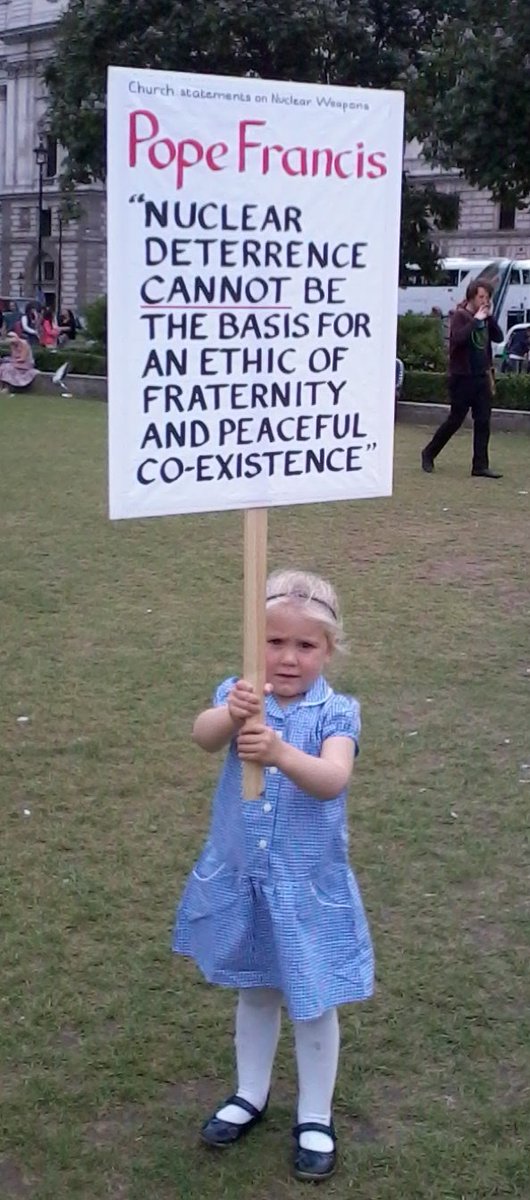
The CND rally went ahead with wise words and tumultuous applause, while on the Parliament side of the square the Christian, Buddhist and other faith groups were for much of the time the main presence.  Who can have a silent vigil amid the roaring traffic and among friends that one has not seen for a year or more?  Nevertheless we prayed, I know we did, and God was listening. We stood with our banners “No Faith in Trident” and placards proclaiming church statements on Trident and nuclear weapons, as a witness against the accepted narrative that was proceeding in Parliament.

We attracted some attention from tourists and commuters, and we  talked with some foreign and freelance media. (UK mainstream media seems only ever engaged by violence.)  We talked about how we knew we would “lose the vote” – we who had no vote!  Yet we know we have the power of logic and humanity.  History shows that truth and goodness and common sense have a way of winning out in the long term.

We know that most countries are on our side, having already decided against the false security of nuclear weapons. It is very likely that next year a ban treaty will be agreed in the UN, making nuclear weapons illegal, as has already been achieved with chemical, biological and other weapons such as antipersonnel mines and cluster bombs, that could never meet Just War criteria.  If you still feel despondent about this go to http://uk.icanw.org/.

Martin Birdseye

Input to the parliamentary meeting on Ethics of Nuclear Weapons

Being an engineer, not a moral philosopher, I think of morality as mostly about standards, the standards by which we contrive to live together in a civilised way.  But most people would agree that it  also includes some basic autonomous principles, as for example, ‘You shall not kill’, which apply in principle for everyone, for all time.

This principle is sometimes difficult to apply, but is nevertheless fundamental in a way that most other rules are not. And it could be said to arise, not from a prohibition, but from a more positive idea of love of, and connection with, our fellow human beings.  We find that the humanitarian impulse is in our nature and so for example, human tragedies, anywhere in the world, cause us deep concern.

So morality, as we know it, may be only a codification of deeper and more complex principles, but it is a vital summarisation on which we base our everyday life.  And ethics is moral philosophy.  There being so much written about it, over two or three thousand years, how can I presume to helpfully explain it to you, in ten minutes?  Simply by introducing you to a tool, designed to help in the application of ethics in this one complex case – nuclear weapons.

The application of ethics in the real world is subject to many difficulties and distortions and the sheer complexity of the problems that we try to resolve.  But judging things for ourselves we look for the nub of the problem, the simple key question that we think we can answer.  This is the approach applied by very many people.  Good, honest, very busy people.  But different people ask themselves different questions and naturally come to different answers. It is not really good enough.

Here, you will be taking decisions on nuclear weapons, that relate to the stability and safety of the world, for a long time to come. It would be foolish to go forward without at least applying the moral principles that we normally live by.  Are nuclear weapons so different that our usual moral principles do not apply?  No.

Are our judgements in this field consistent with the principles that we do apply in the rest of our life?  I think they are often quite different.

Have we considered the whole problem? Or are we focussed on just one or two aspects, like the man-in-the-street who, all too often, has for his ready answer: “North Korea”, or the “expert” that you can call upon, who cites our “vital strategic interest” as if it really was an answer?  This is too simplistic, we owe it to ourselves and our children (and the rest of the world) to really test such a momentous decision.

The tool we are proposing here, to help you tackle this critical issue,  is the Nuclear Morality Flowchart.  Here are all the essential questions, in the right order, in a logical network.  It is simply a decision tree.  You have to make the decisions.  For you, for your individual conscience, it is an ethical algorithm.  That is, it will enable you to arrive at the right answer for you.  You simply start at Question 1 and answer the questions according to the knowledge and moral principles that you own.  It may not bring you to an answer that you like.  Then you may walk away muttering about vital strategic interest, or maybe you will look hard for honest ways to adjust the logic.  That’s fair enough, if you’re prepared to put up for examination your alternative, and equally rigourous plan.  But that’s the challenge.

This issue is a challenge for everyone; we all may have to adjust our ideas.  It’s about deciding whether we should engineer the means to incinerate perhaps millions of people – it’s certainly a moral issue and everyone has a moral stake in it, not only the decision makers.  So we hope and pray (some of us really do) that our decision makers will come to a right judgement.  That is why I commend this to you.  I beg you to use this chart as an aid to an informed, rational moral decision.

And in fact we require of our decision makers that their decision process is  openly rational, logical, and moral.  How could we achieve this?  Simply by asking them to indicate their moral decision path on the ethical flowchart. http://nuclearmorality.com/   It is that easy – the software is organised for you to select your answers to the moral and practical questions on-screen and communicate the solution to your electors.  Or you can use a highlighter pen on the hard copy.

Let’s look briefly at how the flowchart works.  Firstly we limit the scope to morality of nuclear deterrence.  Then we configure all the questions to have simple yes/no answers.  We distinguish between moral questions and the various practical questions which are essential to the logic.  We start with the basic moral statement: “You shall not kill”, appended by a question mark.  Then, whichever way you go from there, you have to examine the moral implications of practical situations.  Everyone, on both sides of the argument, has quite hard questions to answer.

Where does it lead us?

You can see there are three routes out of the chart.  What do they mean for the coming debate?

  • These people here have to renounce the nuclear deterrent. You could say they are unilateralists.  I don’t like that word, because in practice they will work for multilateral disarmament along with these people here.  (Don’t be misled by this, false dichotomy between unilateral and multilateral steps to disarmament.)
  • These people come to a positive, practical rejection of nuclear deterrence. For various reasons they cannot accept nuclear deterrence as a long-term solution.  Many of them may wish to hold off from renewal of Trident, while building a treaty to ban nuclear weapons.  Probably some of them will vote to go ahead with renewal while still taking positive steps towards multilateral disarmament.
  • These people will probably vote to go ahead with renewing Trident and take a rather hard line on disarmament. They will be happy for the UK to continue to ignore the pleas of most of the world (139 governments and numerous recent UN resolutions) asking us to collaborate with the efforts to develop a practical treaty, one which could ultimately incorporate a process, not merely an intention, for disarmament.
  • And none of us, should forget that the world is watching us.

This issue is challenging for all of us. The prospect of having to change our ideas is unsettling.  For you legislators the responsibility of making the right moral judgement makes it even more challenging.  And it is understandable that many in your position will fall back on ‘accepted wisdom’. But what is at stake, the consequences in this particular issue, call into urgent question the conventional mindset. We suggest this process  as a means to encourage and enable you to think afresh.

You have a track record here:  Just over 200 years ago, this parliament, and eventually the rest of the world, voted to make the Slave Trade illegal.  The arguments were often about economics and politics and even national security, but the driving force was the moral issue and that is what is remembered today  –  the slave trade and ultimately slavery itself, became universally unacceptable, morally abhorrent  “repugnant to the principles of natural justice”.  That is why we, and humanity as a whole, can never collectively go back to it.  Our hope is that by making clear moral judgements this parliament will begin to do the same for nuclear weapons.

Martin Birdseye 18/4/2016



Submission to Defence Review

To: Emily Thornberry     Shadow Secretary of State for Defence

In responding to the Labour Defence Review I write as a member of the Labour Party and I am a Co-Chair of Christian CND.  Naturally it is Question 5 of the “Military and Security Forces” section that I wish to address.  I am encouraged that you have effectively put this as a two-part question.  I will deal with these in turn and add some more general comments.

Will renewal of Britain’s nuclear capability aid us in protecting Britain’s security…?”

The short answer is No.

If you can, imagine yourself in an illustrated history book as may be read by our great-grandchildren. The page for our time will show a divided world, divided not East from West, but rich from poor.  The rich will be standing with an arsenal of fantastically sophisticated weapons, enough to destroy everything.  They will be facing a vast army of destitute, helpless humanity approaching in inflatable rafts, threatened every moment by the waves that wash over them.  This picture could not be more macabre, but it is real.  Add to it a few people whose eyes are really open, open to the whole world.  These people weep for humanity and for our own foolishness.  Some of them, in a position to change things, are making a real difference.  Will you be one of those?

Responsibility for Britain’s security must not be thought of in anything but a global context.  Could you at least equalise what we spend on real human security with what we spend on offensive protection?  Will you allow our military expenditure to continue to be subsidised by sale of weapons to those most unstable parts of the world where most refugees come from?

As inheritors of a nuclear mindset, along with the concomitant hardware, we must listen to the increasingly clear message from the rest of the world. Towards the end of last year the First Committee of the UNGA generated a whole series of resolutions which led to overwhelming support for measures to resolve in practical ways the factors which have blocked implementation of Article VI of the NPT for 45 years.

The immediate outcome is the OEWG talks in Geneva, making truly historic progress – nothing less than humanity taking the first steps towards a legal prohibition of nuclear weapons, as has already been done for other classes of WMD.  Britain should be there, in these multilateral negotiations.  Ultimately they will lead to development of a treaty which will include a practical process of multilateral disarmament, not merely a vague commitment as we have now.

And if you need a ‘Britain first’ policy prop, think ahead to potentially profitable roles in such a treaty.  It will require an international agency (e.g. as in Article 8 of the draft Nuclear Weapons Convention, 2007).  Britain has the technical, diplomatic and political know-how to host such an agency.

“Will renewal of Britain’s nuclear capability aid us in … pursuing the values that guide our foreign and defence policy?”

Again, the answer is No – most profoundly No.

We would like to assume that the values that guide our foreign and defence policy are the same as those which guide our lives, both personally and nationally.  We know that this is not always true but we do accept that in general the British people at least like to think so and this is a motivation towards a more humane and generous policy; one that is not obsessed with British security at the expense of the world.

Unfortunately, in the case of nuclear weapons the very opposite is true.  The values are very different:

The utility of nuclear weapons depends on their potential for vast indiscriminate destruction.  This is clearly contrary to the Christian and other traditions of Just War.

Hostage taking is unreservedly condemned in our conventional value system but we use nuclear weapons to make hostages of whole populations.

Nuclear weapons are weapons of terror and blackmail.  The military means that we contrive to maintain this covert and supposedly invulnerable threat allow us to think of them as weapons of war, but in principle this is not different from the covert way in which terrorists deliver their weapons.

Nuclear weapons endanger the whole world.  We have no right to risk the lives of all humanity for the sake of our own security.  In doing so we are taking an exceptionalist position which is now opposed and repudiated by the vast majority of nations, including some which have attained or come close to attaining, and then rejected, a nuclear capability

No-one doubts that nuclear weapons are deployed for reasons of prestige and strategic power politics. There can be no moral justification for this; indeed it is a manifestation of moral weakness, bullying and intimidation.  A denial of our values.

The circumstances where nuclear deterrence might be effective are clearly limited.  However Britain’s nuclear weapons are routinely referred to as the “deterrent”.  It sounds like a good a thing, but in view of all the above this is a misleading euphemism.

The concept of deterrence has been placed at the heart of all attempts at a moral justification of nuclear weapons.  But what appears to some as a legitimate means of protection is to others a preparation for mass murder and unimaginable suffering.  Clear thinking is utterly vital on this issue.  We commend to you the Nuclear Morality Flowchart, an algorithm for the individual conscience and a means for parliamentarians to make their decision-path transparent to their electors. http://nuclearmorality.com/interactive/interactive.html

More general points

Values are important.  In accepting nuclear weapons for our defence we live with an inconsistency in our lives, a denial of some of our moral values.  To cope with this we suppress or segregate the conflicting values but this is not good for the wellbeing and integrity of our nation.

Never doubt that nuclear weapons can be abolished.  The making of nuclear weapons requires a vast amount of engineering.  We employ thousands of professional people just to maintain the technology; it cannot be done in secret and we can decide not to do it.  A treaty to ban nuclear weapons is therefore a very practical possibility.

Economically, technically and militarily Trident is a vulnerable project and may be increasingly embarrassing for whoever is responsible. They will be looking for a way out. Stepping across to some moral high ground from which to scrap it might well be an irresistible temptation. The Tories could do this with no electoral cost and they love being radical. In fact everyone would love them for it. On the other hand Labour could have the vision and the courage to take a lead.

I wish you every success in this major project.

Martin Birdseye  C.Eng MIET


ETHICS OF NUCLEAR WEAPONS

                     Pax Christi UK, Christian Campaign for Nuclear Disarmament                           and the Heston Justice & Peace Group invite you to  a

“DISCUSSION ON THE ETHICS OF NUCLEAR WEAPONS”

An open meeting at the House of Commons

1.30 to 2.45 p.m. Thursday 21st April 2016  Committee Room 5

(please arrive by 1.15 p.m. to allow time to come through security)

hosted by Seema Malhotra MP

Speakers will include Ruth Cadbury MP and the Rev. Dr. Sam Wells

This will be an open meeting to debate the merits of unilateral and multilateral disarmament in achieving a nuclear free world. It will also be an opportunity to debate the ethics of nuclear weapons, regardless of your position on the issue.

The Heston Justice & Peace Group, Pax Christi, Christian Campaign for Nuclear Disarmament have been holding such briefings and discussions with Parliamentarians from across all parties. They have created a Nuclear Morality Flowchart, which is simply a decision tree, a logical network of moral and practical questions designed to encourage and enable a full and rational response to this complex issue.

You can try it now at http://nuclearmorality.com/interactive/interactive.html .

Ask your MP to try it and then send you his or her decision path. The special software makes this easy.

Further information from:  Martin Birdseye 020 8571 1691   077 6274 6895  info@nuclearmorality.com